


Read more
Blog, Blog Posts, Rights, protection and inclusion
Building skills and decent work opportunities for migrant women in Italy
Despite Italy’s long history of migration and the crucial role migrant women play in sectors such as care work, hospitality, and agriculture, their participation in stable and skilled employment remains limited. Recent research on...
Would-be travelers who try to book a visa appointment at a consulate or embassy abroad, particularly of high-income countries, more and more often encounter an online interface. What they don’t find is the same likelihood of securing an appointment—or the same wait time before a slot becomes available.
A new study on a digital visa booking system used by the German foreign office provides systematic evidence that these differences are not random. Instead, they follow a clear global pattern: the poorer a country is, the longer its citizens must wait for a visa appointment. Moreover, in many places the chance of securing a slot at all—no matter when—is extremely low.
Researchers from the Migration Policy Centre at EUI, the German Centre for Integration and Migration Research (DeZIM) in Berlin and the University of Flensburg analyzed more than 16,000 appointment requests for 10 months across 130 German embassies and consulates worldwide. Their results highlight a “time penalty” faced by applicants in many parts of the Global South—a form of inequality that has remained largely invisible until now.
Mapping a subtle form of inequality
Citizens of high-income countries often benefit from visa waivers or streamlined procedures, while most others navigate complex and lengthy processes. Previous research of the MPC’s Global Mobilities Project examined the political and financial aspects of visa access across the world. One element, however, has attracted far less scrutiny so far: time. Long wait spells for visa appointments can delay or derail major life plans—enrolling in university programs, taking up job offers, attending conferences, visiting family, or even making routine tourist trips.
This new study fills that gap by first compiling a large-scale dataset of appointment availability in German diplomatic missions around the world between November 2023 and September 2024. Every six days, a semi-automated program checked when the next appointment would be available at each embassy or consulate. This approach yielded a unique longitudinal picture of the system—one that reveals stark differences across the world.
What the data shows
The study’s findings are straightforward: wait times for visa appointments vary dramatically, and they correlate strongly with economic indicators. Across all queries, 44% of attempts found no appointment available at all. When an appointment is proposed, wait times vary from zero days to more than three months (figure 1). The most extreme delays were reported in parts of Africa, particularly in diplomatic missions in Burkina Faso, Madagascar, and the Democratic Republic of Congo. Across all embassies examined, 17 countries had average waits exceeding one month. Meanwhile, the shortest waits were observed in Europe, Latin America, the Caribbean, and Oceania. Singapore and Cuba stood out with wait times of just two to three days. For applicants, there is no day of the week that guarantees both higher chances and shorter wait times (figure 2).
Overall, countries with higher GDP per capita had shorter waits and higher appointment availability. In statistical terms, the prosperity of one’s country predicts easier access to a visa interview. Nations with closer economic ties to Germany also tended to experience shorter delays. This suggests that smoother international mobility may follow pre-existing trade and economic partnerships.
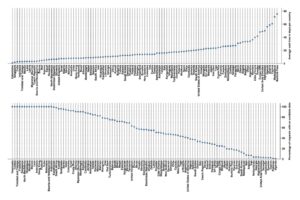
Figure 1: The average wait time and chances of finding an appointment vary strongly between countries. Across more than 50 attempts over a ten-month period, success rates for finding an appointment date ranged from almost zero to 100 percent. (Open the image in a new tab)
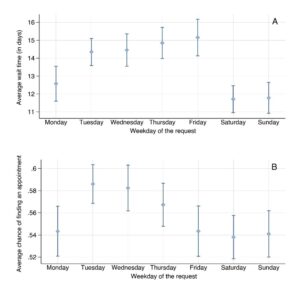
Figure 2: Searching for bookable visa appointments in the German online system on Saturdays, Sundays and Mondays promises the shortest wait times, but the chances of finding an appointment to pick are higher on Tuesdays, Wednesdays and Thursdays. There is thus no day that is optimal for visa applicants in both regards. (Open the image in a new tab)
An opaque process
The study also points to a broader structural issue: Germany’s visa appointment system is notably opaque. Unlike the United States, which regularly publishes up-to-date visa appointment wait times and allows users to monitor changes across consulates worldwide, Germany (as well as other European countries) provides little official information. Most applicants must rely on repeated and frustrating checks of embassy websites, without any clarity about when slots might open or how long processing might take.
All these disparities have implications far beyond individual experiences. Germany is currently aiming to attract international students, skilled workers, and investment. Expert councils have repeatedly emphasized the need to expand legal migration pathways, particularly targeting talents from abroad. Yet the data suggests that for many prospective applicants, the first step toward entering the country—a simple appointment—is disproportionately difficult.
In a policy-oriented perspective, the study underscores the importance of understanding how administrative processes—not just formal migration laws—shape global mobility. As Germany works to modernize its visa infrastructure through digital platforms and unified procedures, the study findings provide evidence-based guidance for ensuring that reforms address underlying inequalities and inefficiencies. Specifically, we propose a transparency initiative (publish current wait times at all German embassies and consulates online to raise plannability and accountability) and a fairness and efficiency initiative (take steps to shorten and balance wait times globally). Such measures, if implemented by the German Foreign Office, could improve the situation for applicants, increase satisfaction with the booking system, and help Germany attract much-needed talent—a win-win situation.
From an academic perspective, the results align with previous research, showing that mobility barriers fall unevenly across the globe—and not only along territorial borders. Visa appointment wait times may appear to be a technical detail, and not even the final step before mobility and migration (what happens in and after the visa interviews remained out of the radar), but they reflect deeper patterns of global segregation. By quantifying these patterns across more than 100 countries, the study offers one of the clearest pictures to date of how time can function as an unseen border. Existing research on “chronopolitics”—the politics of time—focuses on the experiences of asylum seekers, undocumented migrants, or people in refugee camps who endure indefinite waiting, postponement, or slow bureaucratic violence. Our quantitative approach reveals how similar logics function as generalized mechanisms for bordering the Global North more generally.
The study “A Time Penalty for the Global South? Inequalities in Visa Appointment Wait Times at German Embassies and Consulates Worldwide” has been published in the peer-reviewed journal Political Geography.
The German Visa Appointment Dataset is available on Zenodo.