



Read more
Blog, Migration Governance
What do policymakers think are the causes of migration?
Understanding what migration policymakers believe to be the causes of migration and how actual and future migrants respond to different types of policies is essential, as these beliefs shape policies that directly impact the...
Addressing a gap in the migration research agenda
Migration and integration research has long focused on how migrants and their descendants fare in education and the labour market relative to native populations in host countries. This topic has been prevalent in the Global North. However, we know less about the experiences of South-South migrants, that is, those moving within less developed regions of the Global South, despite South-South migration accounting for about one-third of global migration.
This blog post draws on recent findings that aim to fill this gap, focusing on a crucial aspect of migrant integration: the educational achievement of migrant-origin children. Looking at South Americans in Argentina, the study reveals a story of migrant advantages and disadvantages.
South American migration and Argentina’s role as a key destination
Over the past three decades, South American migration has surged, with the number of emigrants rising from 2 million in 1990 to over 8 million by 2020. Argentina has become a primary destination due to its relative stability, economic opportunities, and supportive immigration policies, especially within the MERCOSUR agreement. While European migrants once dominated Argentina’s migration scene, today’s immigrant population largely consists of individuals from South American countries, particularly Paraguay, Bolivia, Peru, Chile, and, more recently, Venezuela.
Key findings: Educational outcomes of migrant-origin children
Using 2010 census microdata, the study investigated the school attendance and educational levels of children with Bolivian, Paraguayan, Peruvian, and Chilean origins, focusing on two groups: 2nd generation children born in Argentina to longer-term resident migrant parents and 1.5-generation children born abroad and arrived with their parents more recently[1]. I compared their educational outcomes with those of native Argentines, controlling for variables known to affect educational attainment: parental education, household resources, and neighborhood characteristics. The study reveals significant differences in educational outcomes, which tend to depend greatly on how educated parents are.
Migrant advantage: Higher school attendance and completion rates
The findings showed that, after accounting for controls, migrant-origin children are, on average, equally or even more likely to attend or have completed secondary school than their native Argentine peers.
These results can be observed in Figure 1, which illustrates the findings for two key indicators: secondary school attendance among 14–18-year-olds and secondary education completion for those aged 19–21. Migrant-origin children show attendance and completion rates 3% to 10% points higher than their native Argentine peers. For example, 2nd generation Bolivians are around 9% points more likley to attend secondary education and 10% points more likley to have finished this level than native Argentines, on average.
Figure 1: Educational outcomes of migrant-origin children (vs. native argentines)
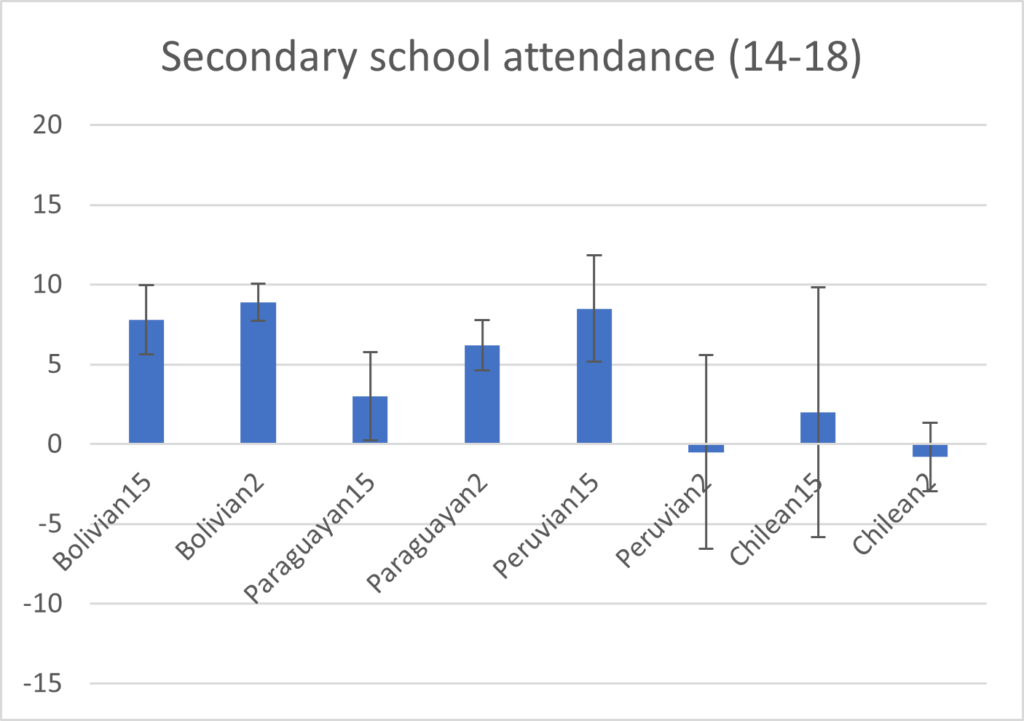
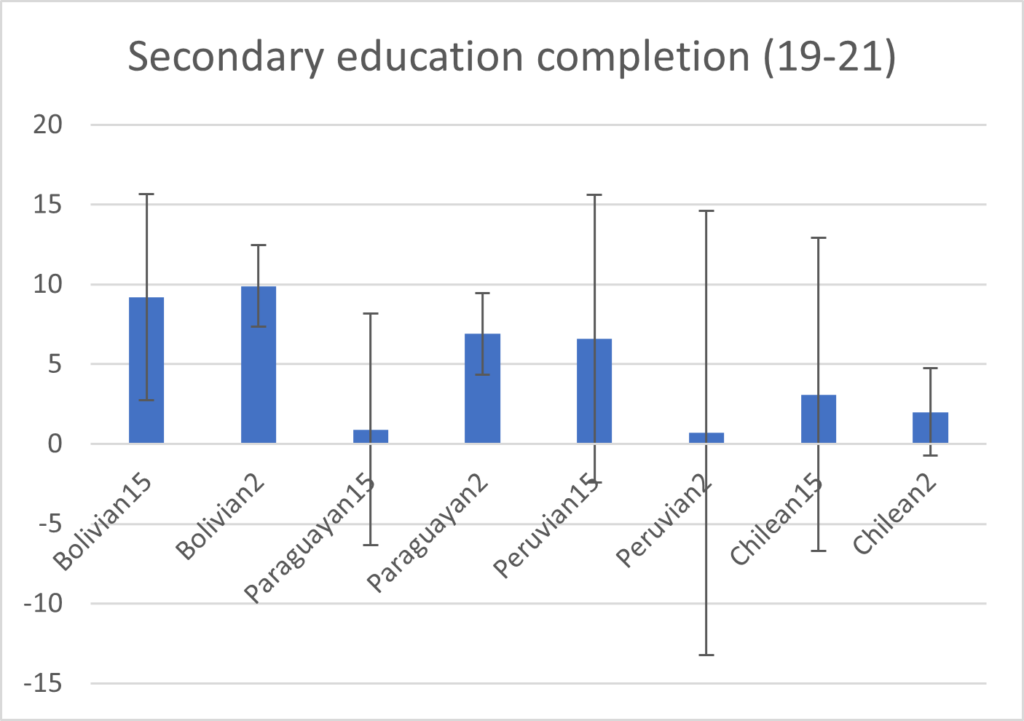
Average marginal effects derived from logistic regressions (95% confidence intervals). They express the difference in percentage points with respect to native Argentines. For controls, see footnote [2].
Migrant advantage with nuances: variation by parental education
A closer look at parents’ education levels revealed more nuanced results. In general, the migrant advantage applies only to those with low-educated parents. Conversely, among those with better educated parents, migrant-origin children have similar or even poorer results compared to Argentine natives of similar parental education.
Figure 2 illustrates both of these findings. In the charts below, we see how the difference between each migrant-origin group and native Argentines (y-axis) varies by parental years of education (x axis).
Figure 2: Educational outcomes of migrant-origin children (vs. native argentines), by parental years of education
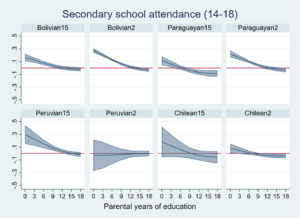
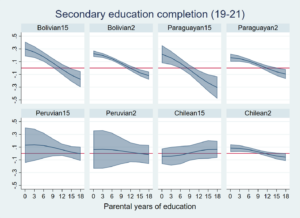
Average marginal effects derived from logistic regressions (95% confidence intervals; zero line in red). They express the difference with respect to native Argentines, for each parental year of education (percentage points when multiplied by 100). Controls as in Figure 1.
Educational mobility among children of low-educated parents
Migrant-origin children from families with low levels of parental education demonstrate a marked advantage over native Argentines with similar backgrounds, especially those with Bolivian and Paraguayan origins. For example, 2nd-generation Bolivian and Paraguayan children with parents having 7 years of education (which approximates primary education) are around 10% points more likely to attend secondary school than native Argentines with equally educated parents.
Diminished advantages for children of highly educated parents
These educational advantages diminish—and sometimes even reverse—among those with higher educated parents. For example, among 1.5 generation Paraguayan children with parents having 12 years of education (which approximates secondary education), secondary school attendance and secondary education completion rates are roughly 10% points lower than those of their native Argentine peers.
These findings highlight the critical role of parental education in shaping educational outcomes across groups.
Possible explanations: motivation and class-based resource gaps
Overall, the study reveals significant differences in educational outcomes between migrant-origin children and native Argentines. Migrant-origin children, especially those with low-educated parents (which includes most Bolivians and Paraguayans) often outperform their native peers. However, for children with higher-educated parents, there is no difference, and sometimes even a disadvantage. While direct testing of mechanisms is not possible, the literature suggests two potential factors that explain these findings:
High motivation for education
Motivation and parental aspirations likely play a role in explaining why children of migrants often outperform their Argentine peers across various educational outcomes. Migration is frequently a family endeavour, driven by aspirations not just for the adult migrants, but also crucially for their children. In this context, education stands out as a central goal among migrants’ social mobility strategies, a well-documented finding in the Global North, and also among South Americans in Argentina. This results in increased encouragement to study or a more strategic approach to school selection, contributing to their children’s educational success.
Limited access to class-based resources
For migrant-origin children of highly educated parents, limited access to class-based resources may diminish educational advantages. Higher-educated parents often have higher incomes and additional socioeconomic resources, which can positively affect their children`s education—through e.g., payment of individual tutoring or private school. However, migrant families (especially the most recently arrived ones) often find themselves in less qualified jobs with lower average incomes despite high levels of education. This may limit their ability to provide their children with the same advantages as Argentine natives.
Conclusion
Understanding the complex interplay of migrant origins, parental education, and socioeconomic factors, is essential for assessing the educational achievements of young people in Argentina. By unpacking these elements, we can develop more effective strategies to understand and support the educational journeys of both migrant-origin children and native Argentines in a country where educational inequalities remain significant.
——
Carolina V. Zuccotti is a sociologist from Argentina and a former research fellow at MPC. As a Marie Skłodowska-Curie (MSCA) Global Fellow at theUniversity Carlos III Madrid, she coordinated the project GLAM – Global South Migration and Comparative Integration: A Study of South American Migrants. She will soon be starting a new position as a Ramón y Cajal Fellow at Universidad Nacional de Educación a Distancia, Madrid.
Acknowledgement: This research is part of my project GLAM – Global South Migration and Comparative Integration: A Study of South American Migrants, which has received funding from the European Union’s Horizon 2020 research and innovation programme under the Marie Sklodowska-Curie grant agreement No 101023322.
Footnotes:
[1] The study focused on young people of school age and recent graduates within the formal education system who were living with their parents. Out of the almost 4 million cases, 3.3% had migrant origins.
[2] Note: differences are statistically significant, meaning they hold true at a 95% confidence level, when confidence intervals do not overlap with the zero line. Control variables included are: parental years of education, sex, age, period of arrival (own and parental), parental activity status, five indicators of unmet basic needs, housing tenure (owner or not), the province of residence and the proportion of household heads with up to primary education in the department (there are 526 departments in total).