



Read more
Blog, Mobility Practices and Processes
Giving voice to the voiceless? The realities of interviewing irregular migrants in Croatia
Irregular migrants remain one of the most invisible and vulnerable groups in Europe. While their legal rights are already limited compared to asylum seekers and regular economic migrants, their ability to exercise these rights...
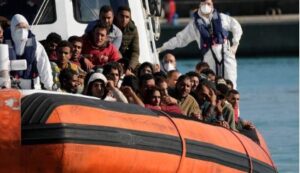
A rescue boat approaches an overcrowded dinghy off the coast of Italy. Officers in biohazard suits reach out to help migrants onboard. This is the image many Europeans see when they think of irregular migration. But what’s missing from the frame?
In this post, I explore how media images in Europe and Africa portray migration differently — and why that matters. As a postdoctoral researcher on the Shut-Med Project — which investigates the securitization of migration across the Mediterranean — I draw on an analysis of newspapers in Italy, Malta, Libya, and Niger to argue that these visuals create a “politics of invisibility”: they don’t just inform public understanding — they shape it.
From health threat to security risk: Framing migration in Europe vs. Africa
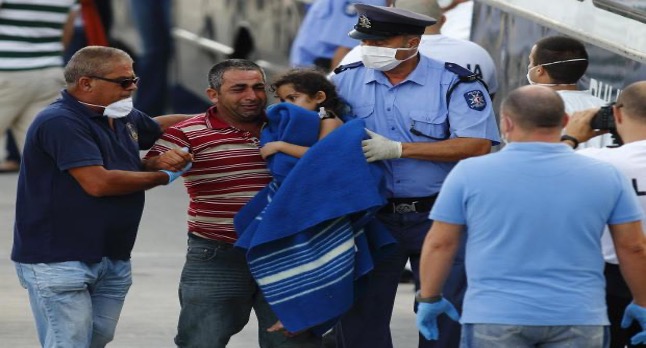
European media have long framed migrants as both at risk and a risk, a duality that plays out powerfully through pictures. In Italy and Malta, pictures of border agents clad in full biohazard suits became common well before COVID-19. In fact, data from 2013 to 2023 show that over 60% of pictures in conservative newspapers like Il Giornale and The Times of Malta depicted border personnel wearing some form of biohazard protection, with the trend spiking during the Ebola crisis and again during the pandemic.
But these pictures do not reflect real health policy; they’re part of a pattern, a visual playbook. While the presence of biohazard gear is ostensibly tied to outbreaks, the timeline tells another story: biohazard suits appeared in European newspapers even when no active public health crisis existed, reinforcing a narrative that frames migrants as potential disease carriers. Meanwhile, Libyan and Nigerien newspapers—such as Al-Marsad (2016–2023), Aïr-Info Agadez (2017–2018) and L’Événement (2020–2021) show almost no use of biohazard imagery. Their visuals feature soldiers, guns, and desert checkpoints, not facemasks and gloves—language that casts migration in terms of physical security. Migrants may be a risk to the state, not to its immune system.
What this contrast reveals is stark: In Europe, the health security frame justifies containment and legitimises emergency measures, even when the acutual risk of disease? is minimal. In Africa, the absence of medicalised pictures reflects not a lack of concern but a different politics, one where irregular migration is not managed through sanitised control measures.
From boats to detention centres, from sea to sand
In Europe: Migration at sea
In Italy and Malta, irregular migration is visually anchored at sea. The archetypal image is the overcrowded boat, a precarious vessel met by masked officers, rubber dinghies intercepted by both Italian and Maltese coast guards. These pictures frame migration as a spectacle of arrival, a humanitarian or sanitary emergency. But as we move south, to Libya and Niger, the landscape changes, and so does the frame.
In Libya: Migration on land
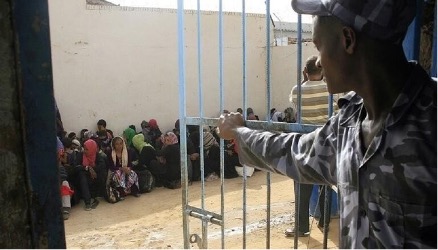
In the Libyan media outlet LANA, only around 5–10% of migration-related pictures depict boats or sea rescues. A few notable exceptions show shipwrecks or Libyan Coast Guard rescues, such as the 2022 Sabratha tragedy. However, the dominant visual shifts inland: desert patrols, detention centres, and military control. Pictures often show migrants seated on the ground, corralled near buses or concrete walls, flanked by armed agents. The sea is no longer the central stage.
Instead, the focus is on what happens far before, in the desert, which includes portrayals of death. Dead bodies appear more visibly in Libyan outlets than in European ones. In contrast to Europe’s sanitised gaze, Libyan media allows glimpses of the consequences, even if still mediated through state-controlled visual language.
Niger: Where the desert speaks in silence
Niger’s newspapers rarely show the sea—because migration there plays out in the desert. Though the number of images is limited, the dominant visuals from outlets like L’Événement and Air-Info Agadez portray armed soldiers in arid, vast desert terrain, intercepting trucks full of migrants The landscape tells its own story: dusty roads, open skies, soldiers in fatigues, pickup trucks.. Migration is portrayed as something to be stopped, not supported. Just like in Libya, there is no visual narrative of rescue, only one of tracking, blocking, and removing.
And while detention infrastructure is less visually codified in Niger than in Libya, the militarised presence of the state performs the same function: migration is shown not as suffering, but as something to be stopped, surveyed, and controlled.

The invisible journey
The visual analysis demonstrates that border enforcement routines along the Central Mediterranean Route have become iconic representations within the visual discourse on migration. Once captured and circulated through media images, these routine practices—such as disembarkations, patrols, or detentions—take on a symbolic function. They do not merely document events but actively participate in constructing a securitised narrative of irregular migration. Crucially, what is left outside the frame often matters more than what is inside it. This is the politics of invisibility: migrants are portrayed as risks rather than people; suffering is blurred, death remains off-camera, and the presence of control is constant and unquestioned. This is not accidental. It reflects a broader strategy: to make migration visible only as a problem to manage, never as a human story to reckon with. Visibility becomes a form of governance, one that depoliticizes suffering, obscures responsibility, and protects the illusion that Europe’s borders are maintained humanely. The journey that matters most—through deserts, prisons, and political neglect—remains unseen.
—
Diego Caballero-Vélez is a postdoctoral researcher at the University of Messina, working on the Shut-Med project “Securitization of Human Mobility in Italy, Malta, Libya, and Niger”. He was formerly a short-term visiting researcher at the Migration Policy Centre at the European University Institute. He is the author of Contesting Migration Crises in Central Eastern Europe: A Political Economy Approach to Poland’s Responses Towards Refugee Protection, published with Palgrave Macmillan.