Read more


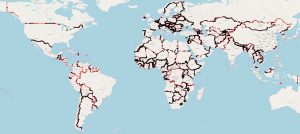
The permeability of national borders significantly affects the flow of people, goods, and services, influencing trade, migration, and economic development. The Border Permeability Dataset provides detailed information on 312 land borders worldwide, measuring permeability based on cross-border transport infrastructure and checkpoints.
This dataset is vital for analysing global issues such as international trade, economic inequality, migration flows, and the ethnic and cultural composition of border regions. It offers researchers and policymakers valuable insights into how infrastructure and policy impact global connectivity and development.
The dataset uses automated computational methods, combined with manual verification, to gather data from OpenStreetMap and the World Food Programme. It provides information on approximately 40 types of infrastructure and border controls, including:
Research based on this dataset has yielded significant insights into global border permeability patterns:
Most and Least Permeable Borders: Borders in Europe and Africa are the most permeable, while those in the Americas tend to be less permeable, even when accounting for checkpoints.
The Role of Population Density and Economic Development: Borders in densely populated areas tend to have higher permeability due to greater infrastructure investments. Interestingly, the dataset reveals a curvilinear relationship between economic development and border permeability: Highly developed and very underdeveloped countries tend to have the most permeable borders; Moderately prosperous nations often maintain stricter, less permeable borders.
Transport and Control Balance: More transport infrastructure increases permeability, but checkpoints provide the political capacity to reduce or control border crossings. These two factors interact to shape the accessibility and security of borders worldwide.
Read more

Read more
External resource
Read more