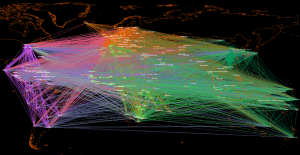


The Global Transnational Mobility Dataset

Mapping international mobility worldwide

Over recent decades, international travel has expanded dramatically, reaching roughly 10 billion trips per year, about twice the level of the mid-1990s.

Yet, comprehensive data on these population flows has been scarce so far. The Global Transnational Mobility Dataset provides estimates of country-to-country travel based on combined tourism, air passenger, and migration statistics.

This dataset (Global Transnational Mobility Dataset, GTMD 2.0) expands on an earlier version (GTMD 1.0) which covered the 2011-2016 period. GTMD2.0 records over 150 billion cross-border trips from 1995 to 2022. This dataset improves upon previous efforts by offering more accurate estimates and comprehensive coverage of mobility flows on a planetary scale.

Researchers can use the dataset to explore critical questions such as:

  • How do border control policies affect global mobility?
  • What economic and political factors influence the volume and direction of human mobility across the planet?
  • How does international mobility align with global inequalities?

Key Findings

Regional imbalances: The majority of cross-border travel occurs within continents.

  • Europe leads with over 6 billion annual intraregional trips, followed by East and South-East Asia, which experienced the largest increase since 1995.
  • In contrast, regions like Africa and Central Asia see significantly fewer trips, widening the global mobility gap.
  • Regional clusters of population movements are tendentially stable but not entirely immutable over time, reflecting changing geopolitical alliances and levels of socioeconomic development.

Mobility as a driver of globalisation: This dataset showcases the ‘human dimension’ of globalisation.

  • People, not just goods and capital, have been increasingly crossing borders since the late 20th century.
  • The COVID-19 pandemic abruptly interrupted the constant and steady growth in the global volume of international mobility in place since the late 20th century. The pre-existing trend, however, was re-established already in 2022.
  • Cross-border movements are stratified by wealth and opportunity, with richer countries generating a disproportionately large share of travel.

Explore the Dataset

The Global Transnational Mobility Dataset 2.0 is available as an open-access resource. Users can download it from Zenodo.

Read the related interview, ‘Beyond migration: capturing the richness of global human mobility‘, with authors of the dataset Ettore Recchi and Tobias Grohmann.

Explore the Global Transnational Mobility Dataset

Back to top