



Read more
Blog, Blog Posts, Labour markets & welfare states
High hopes, hidden scams: How seasonal workers from Central Asia fall prey to scammers
Following Brexit and Russia’s full-scale invasion of Ukraine, Central Asian labour migrants have played a key role in addressing UK agricultural labour shortages. In 2024, workers from Kazakhstan, Kyrgyzstan, Tajikistan, and Uzbekistan accounted for...
When people think about ‘irregular migration’ to Europe, they usually picture dangerous boat crossings or jumping over barbed wires at land borders. But there is another, much quieter and more frequent pathway—one that begins at an airport passport control desk with a perfectly legal stamp.
Every year, millions of individuals enter the Schengen Area on short-term visas for tourism, business, or family visits. Most leave before the visa expires. A few do not. These ‘overstayers’ make up a substantial but largely invisible share of irregular migration in Europe. As part of a large EC-funded research project (called MirreM), a recently published study offers an unprecedented picture of the size of this phenomenon from outside Europe.
Measuring the invisible
Counting overstayers is notoriously difficult. By definition, they are not registered as residents, and unlike asylum seekers, they do not pass through dedicated administrative systems. We tackled this problem by combining multiple data sources to estimate how many persons enter legally and then remain unlawfully (by overstaying their permits). The focus is on the Schengen Area, where internal borders are open but external borders are tightly regulated. This makes overstaying especially relevant: once inside, people can move freely across most of Europe.
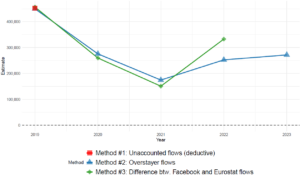
Figure 1: Estimates of yearly incoming visa overstayers from non-European countries in the Schengen Area (2019-2023): summary of the three methods. Source: Recchi, Bernasconi and Rodriguez Sanchez (2026).
The key contribution of our study is not just a single number, but a method with three variants— two using airline passenger data, and one leveraging Facebook data. In all variants, the method compares the volume of incoming and outgoing travelers and discounts the size of regular migration flows.
In the period 2019-2023, for which data were available, our three variants converge around 450,000 newly incoming overstayers in 2019, 250-300,000 in 2020 and 150-350,000 in 2021-2023—which corresponds to about one person per 1,000-3,000 residents in the Schengen Area (figure 1). Data cannot say how long these overstayers stay irregularly thereafter.
Where do overstayers come from?
A common misconception is that overstayers mainly come from one region or one type of country. In reality, the picture is more diverse. Our estimates suggest that overstayers originate from a wide range of regions, including Latin America, North Africa, Sub-Saharan Africa and South Asia. No single region dominates completely. This diversity of origin means that overstaying cannot be addressed through bilateral agreements with just one or two countries, nor through measures targeting a single migration route.
Why overstaying matters
From a policy perspective, overstaying poses a dilemma. On the one hand, short-term visas are essential for tourism, business, and diplomacy. The Schengen Area thrives on international mobility, as other MPC-based studies have shown. On the other hand, overstaying undermines the credibility of visa systems and fuels political narratives about ‘loss of control’. Yet overstaying is not primarily driven by weak enforcement at airports or borders. Instead, it reflects broader structural factors: labor demand in destination countries, limited legal pathways for long-term migration, and unequal global mobility regimes. For many overstayers, a tourist visa is not a loophole—it is the only realistic legal entry point.
Rethinking migration control
One of the most important implications of our work is that tougher border controls alone are unlikely to reduce overstaying in a lasting way. As long as short-term international mobility exists—and it must, for economic, political, social, and ethical reasons—some degree of overstaying will persist.
This opens the door to alternative approaches:
- Expand legal pathways for work or study that allow people to transition from short-term to long-term status without pushing them into irregularity.
- Create targeted regularization programs that acknowledge the reality of long-term overstayers who are already socially and economically embedded.
- Improve data systems to better track exits, not just entries.
In line with the last point, the European Union is currently starting to implement its own entry/exit system. The system collects the personal information of any incoming traveler and checks whether they leave within the 90-day time limit. Explicitly, one of its main goals is to prevent overstaying. But rather than treating overstayers solely as a failure of enforcement, the study invites us to see them as a predictable outcome of how Europe manages mobility and as a response to the inflexibility of migration systems.
The quiet side of migration
Overstayers rarely make headlines. They do not arrive en masse, and they do not fit neatly into public debates about borders and asylum. Yet, as this research shows, they are a central part of Europe’s migration reality.
Understanding overstaying does not mean endorsing it—but it does mean acknowledging that migration systems work in complex, sometimes unintended ways. If Europe wants a migration policy that is both effective and realistic, it cannot afford to ignore the people who arrive legally and stay quietly. Sometimes, the most important movements happen after the passport stamp has faded.
Read the full study ‘Short‑Term Visa, Long‑Term Stay? Estimating Inflows of Overstayers in the Schengen Area Using Air Passenger Records and Facebook Mobility Data’ by Ettore Recchi, Luca Jonas Bernasconi and Alejandra Rodriguez Sanchez.