

-

Caitlin Procter
Part-time Professor
Robert Schuman Centre for Advanced Studies
Read more
Blog, Public Attitudes
The contradictions in Hungary’s immigration policy and communication
In his recent speech, Hungarian Prime Minister Viktor Orbán declared, “By 2035, Hungary must be demographically self-sustaining. There can be no question of population decline being compensated by migration. The Western experience is that...
The mass displacement of Palestinians in Gaza over the past year raises urgent questions for migration policymakers and researchers about how we understand and categorise migration. Traditional migration and displacement definitions, shaped by historical narratives and legal frameworks, struggle to capture the reality of repeated forced movement within confined spaces under siege. This blog explores the inadequacies of current legal categories in addressing the plight of Palestinians in Gaza during and following the repeated evacuations ordered by the Israeli military.
The reality of displacement on the ground
On October 13th, 2023, the Israeli military ordered 1.1 million Palestinians to evacuate northern Gaza within 24 hours to “safe zones” south of Wadi Gaza. Amid heavy bombardment and communication blackouts, information was dispersed through recorded messages, texts, and leaflets dropped from the sky. “This is exactly how they did it in 1948”, commented a colleague in Gaza at the time.
Panic ensued as families, unsure of where to go or how to get there, scrambled to make sense of the order to leave their homes. The elderly, pregnant women and people with disabilities faced nearly impossible decisions. As one colleague texted to me at the time:
“After three days with the same horrifying atmosphere, no sleep, my eyes are falling closed. Yet my head is shaking me to keep awake, never knowing what will happen, never knowing if the next bombing will get us, or force us to evacuate like thousands who have already evacuated their homes. We’ve prepared an ‘evacuation’ bag, but the scenario of evacuating is a nightmare. With my disabled 83-year-old mother in a wheelchair, my terrified dog, but, of course, with my strong wife. But we haven’t prepared yet where to evacuate to. Where to go? The choices are zero. Any movement toward any other family members in other cities is already a suicide attempt. Nearby, friends are already hosting many of their family members. Maybe staying inside the car would be an option?”
Moving from grid to grid: searching for a ‘safe’ zone
Despite being designated as “safe,” the routes to these areas were obstructed by shelling and sniper fire. Those who managed to reach these zones found themselves under continued bombardment there, too. Of the roughly 500 two-thousand-pound bombs dropped in the first six weeks, 42% were in the designated safe zones in the south. By October 28th, two weeks after the mass evacuation order, 38% of the killings in Gaza had occurred in these so-called safe areas.
After the weeklong ceasefire, the Israeli military communicated plans to attack the south, specifically areas that had previously been designated as ‘safe’. The army publicised an “evacuation grid”, breaking Gaza down into more than 600 blocks, claiming to add clarity on which areas would be targeted. From early December, Palestinians were routinely ordered to move, in accordance with the grid, to areas listed to be safe but which were subsequently targeted. As Palestinians were displaced from one place to the next, many families became separated.
The Rafah Crossing and Costly “Freedom”
By early February 2024, 1.4 million Palestinians had been displaced to the southernmost region of Gaza, Rafah. Living conditions were deplorable: shelters, hospitals, and health centres were used as makeshift accommodations, while thousands slept in tents. Finding materials to build shelters was nearly impossible due to limited aid, and inflation made food prices prohibitive. With the population confined to this small area, the Israeli government began discussing plans to evacuate Rafah, threatening an imminent ground invasion.
As routine displacement within Gaza continued, the opportunity to pay for escape was available via an Egyptian “travel agency” facilitating passage from Gaza to Egypt for hefty fees. While before October 2023 these fees typically ranged from hundreds to thousands of dollars, they soared to $10,000 per person during Israel’s attack. After limited international condemnation, the process was formalised with capped fees of $5,000 per adult and $2,500 per child. Many began crowdfunding to pay these sums. However, the Israeli military’s seizure of the Rafah crossing in May made escape impossible, even for those who had paid.
Until today, evacuation orders continue to force Palestinians to move around Gaza, often carrying their tents with them. 1.9 million Palestinians have now been forcibly displaced in Gaza, many of them upwards of ten times within a single year. These repeated ‘evacuation orders’ within a confined area with no safe passage or refuge fall under the legal definition of forcible transfer, violating Article 49 of the Fourth Geneva Convention. But this category is somewhat helpless in either providing relief to Palestinians in the present or with lasting recourse to justice in the future. The dismantlement of humanitarian support and implications for legal refugee status adds to the inadequacies of existing migration categories.
Why the collapse of humanitarian support signals collapsing legal definitions
The definition of Palestinian refugees was established in law following the mass displacement of Palestinians in 1948 during the establishment of the state of Israel. The United Nations Relief and Works Agency (UNRWA) was subsequently established and has, for decades, provided essential services, including education, healthcare, and emergency relief, to Palestinian refugees—who, prior to October 2023, comprised two-thirds of the population of Gaza. There were 8 refugee camps in Gaza alone.
There have been systematic efforts to dismantle UNWRA over the past year. False accusations against the agency led to funding suspension from multiple states, severely restricting its operations. With ruthless disregard UN facilities and personell, at least 220 UNRWA staff have been killed by the Israeli military and an unknown number have been detained. At least 190 UNRWA schools and health clinics have been severely damaged or destroyed, many of which were housing displaced Palestinians. The Israeli military’s targeted restrictions on UNRWA’s access to northern Gaza have further impeded its ability to assist those most in need.
While in 1948, UN agencies were established to address the scale of this displacement, now the agency designated to serve Palestinian refugees is being systematically weakened by Israeli attacks and the failure of the international community to effectively intervene. This signals more than just an organisational collapse; it indicates a broader erosion of the legal framework that defines and protects Palestinian refugees. This raises grave concerns about the future of refugee law and the global commitment to upholding the rights of those forcibly displaced.
The inadequacy of migration categories
Even before the displacement witnessed over the year, the Israeli-Egyptian 17-year blockade of Gaza had already posed complications in using distinct migration categories to explain displacement. In my previous research on Gaza, this is something I have described using a framework of coercion: a series of often hidden processes designed to depopulate Gaza by making the situation so dire that Palestinians were forced to leave. These inadequate migrant categories have become even more apparent this past year.
Definitions of migration and displacement, predominately shaped by historical narratives and legal frameworks, face an urgent reevaluation in light of contemporary realities. How can we capture and respond to the reality of families being forcibly displaced upwards of 10 times in the space of a year in a small stretch of land? How can the refugee definition evolve to embrace the realities faced by displaced Palestinians in Gaza? What happens if it does not? Will it make any difference, given the complete failure of the refugee status, to lead to any return, restitution or compensation of Palestinians since 1948? These questions pose serious challenges to the meaning of refugee law and migration governance in the face of genocide.
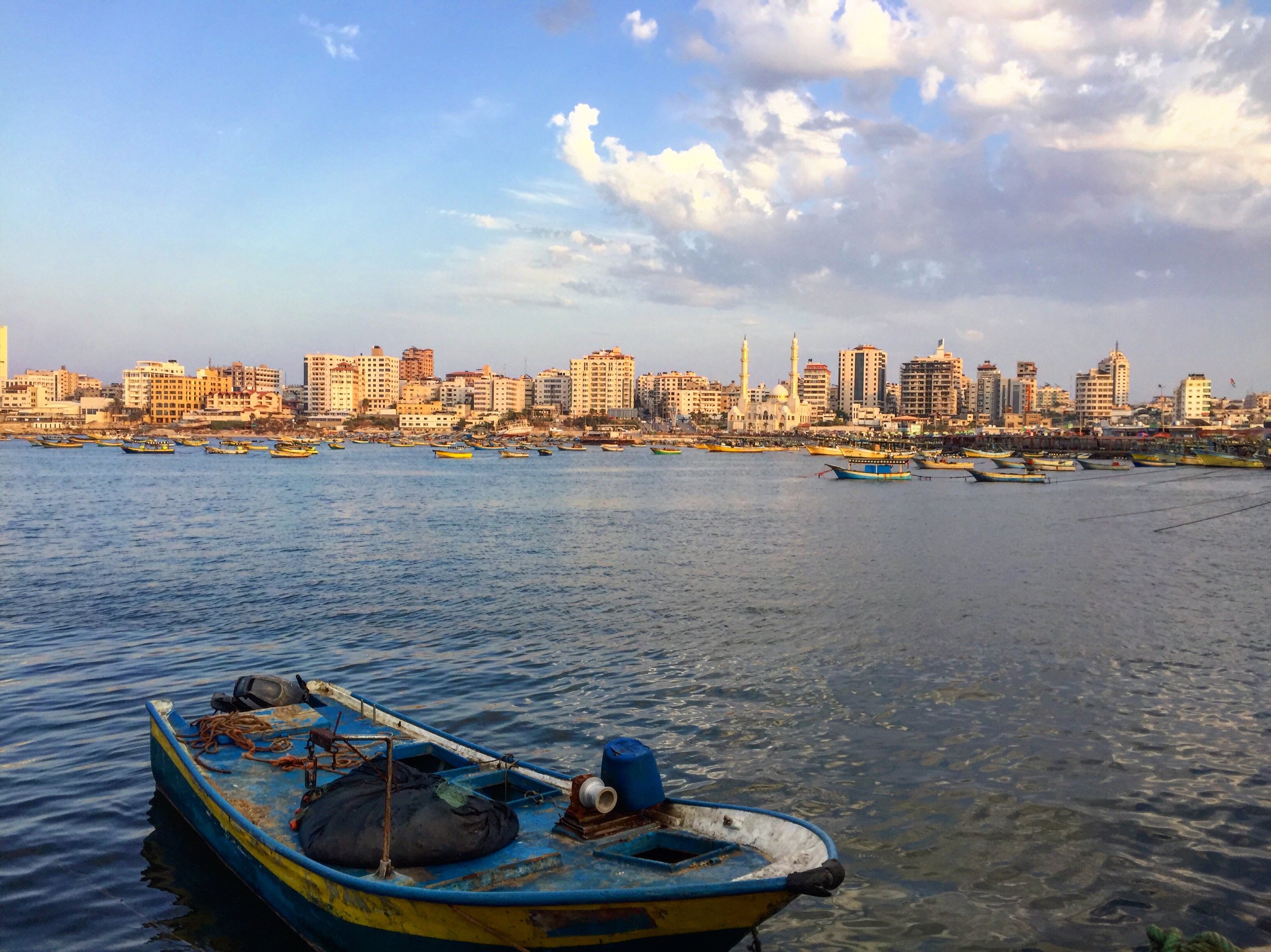
Photo:: Gaza City port. © Caitlin Procter, 2018